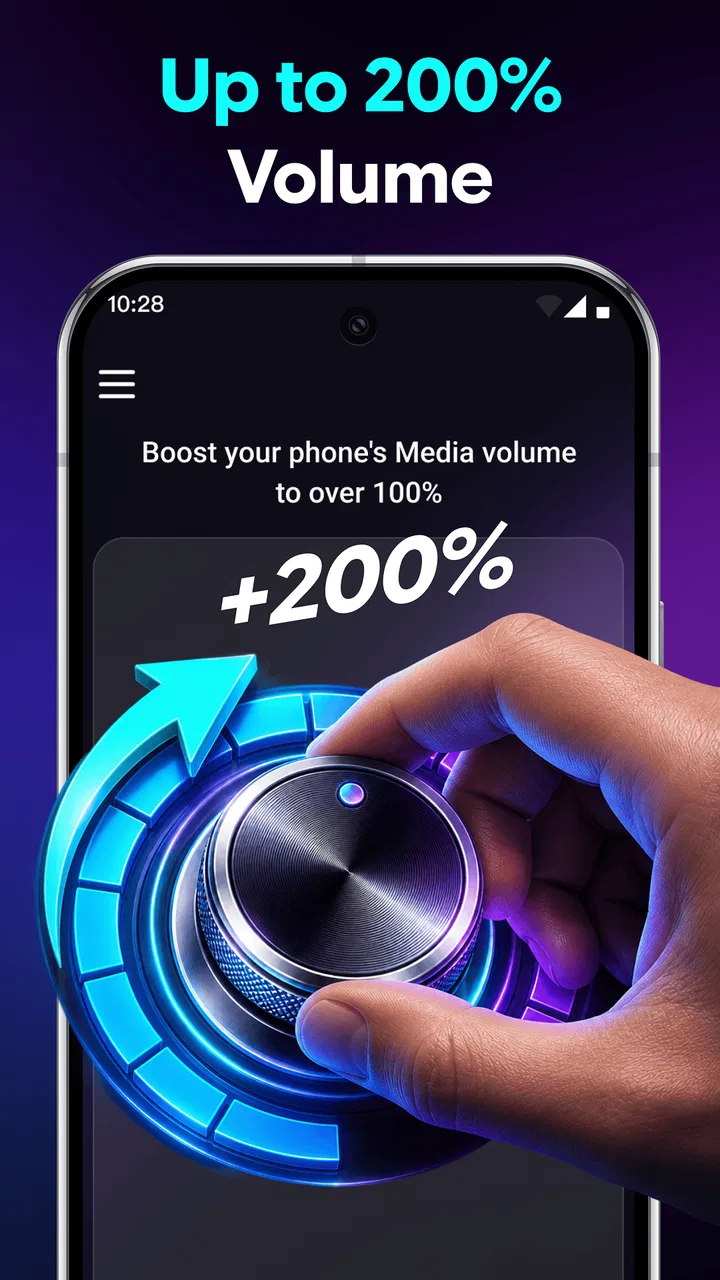
Volume Booster–Sound Enhancer
- 4.5
- Rating
- 100.00K
- Installs
- Free
- Price

 Analysis by App-foxy
I usually approach volume tools with a little caution because a louder phone is not automatically a better-sounding phone. Volume Booster–Sound Enhancer is a free Android utility from OXENAAR that focuses on making media volume easier to increase and control. After using it as a practical sound-control tool, I found its appeal is straightforward: it can be useful when the phone’s normal output feels too quiet, but it should be treated as a listening aid rather than a replacement for good speakers or headphones.
The app sits in the tools category and is suitable for Everyone. Its current version is 1.0, and it supports Android 8.0 and later. That makes it accessible to many older phones as well as newer devices. It has reached over one hundred thousand installs and holds a 4.5 average from around two thousand ratings, which suggests that the basic idea is working for a meaningful group of users. Still, those figures do not remove the need to test it carefully on your own phone, since sound hardware varies considerably from one model to another.
How the app feels during everyday use
I’ll focus on how the app fits into ordinary listening, including the small checks that help me tell whether a volume change is genuinely useful or merely louder. I’d also pay attention to how the phone behaves when switching between speakers and headphones, since that is where a comfortable setting can quickly stop being comfortable.
You May Also Like

 Blood Strike: 2.5 Anniversary
Blood Strike’s Loadouts Turn Every Drop Into a Tactical Gamble
A close look at Blood Strike’s custom loadouts: how fast access to signature weapons reshapes its battle royale rhythm, rewards preparation, and narrows the gap between fights.

 Pandora - Music & Podcasts
Pandora’s Music Is Easy to Start, but Harder to Recover
Pandora’s strength is its low-effort path from a seed to a station. Its weak spot is how much confidence it asks you to place in connection, setup, and quiet recovery.

 8 Ball Pool
 Is Built on Rivalries, Rematches, and Routine
A close look at the rivalries, rematches, shared routines, and unanswered safety questions that turn a quick pool match into a persistent mobile community.

 Samsung Music
’s Quiet Strength Is Playing What You Already Own
Its reach comes less from spectacle than from dependable access to a personal library. That simplicity is both the app’s strongest retention engine and its ceiling.

 AccuWeather: Weather Radar
AccuWeather Review: A Quick, Clear Forecast for Everyday Decisions
For everyday plans, the best forecast is the one you can understand quickly. AccuWeather makes rain timing, radar, and local conditions easy to act on, with a few trade-offs.

 Hill Climb Racing
Why Hill Climb Racing Still Turns Crashes Into One More Run
A tiny car, a bumpy hill and one more upgrade: Hill Climb Racing keeps resurfacing because its simple chaos makes every near-miss feel personal.
More From Our News Desk



Quick changes matter more than complicated controls
The main strength of this app is its direct purpose. Instead of searching through several Android menus every time media sounds too quiet, I can use a dedicated volume utility to make an adjustment with less interruption. That is especially handy when switching between a podcast, a video, music, and a game, because each type of content can be mixed at a different loudness.
I would not describe the experience as a dramatic transformation of the phone. The result depends on the device’s speaker, the audio source, the headphones being used, and the level already allowed by Android. On some phones, the difference may feel immediately useful; on others, the gain may be more modest. The important point is that the app is aimed at improving control over media volume, not at repairing damaged speakers or creating studio-quality sound.
In terms of perceived speed, a volume tool has a fairly simple job. I expect the control to react promptly when I use it, without making me wait for a long screen or a complicated setup process. Volume Booster–Sound Enhancer fits that kind of lightweight workflow better than a full audio-editing application would. It is the sort of utility I would open for a quick correction rather than leave running as part of a demanding daily routine.
A realistic evening scenario
One practical example is watching a video in a room where other people are talking quietly. The phone’s regular media level may be technically high but still difficult to follow, particularly with speech that has a narrow volume range. I can use the booster to make the dialogue easier to hear, then reduce it again when the scene becomes louder. That small adjustment is more useful than simply leaving every app at maximum volume.
There is a trade-off here. Increasing loudness can also make harshness, distortion, or background noise more noticeable. If voices become uncomfortable or music starts sounding brittle, I would lower the level rather than keep pushing it. A good result is not the loudest possible output; it is the point where the content becomes clear without making the speaker struggle.
What happens during heavier use
Heavy use for this kind of app is different from heavy use for a game. The demanding moment is usually not a long session inside the booster itself, but repeated switching between media apps while changing volume. I would use it while moving from a video call to a streaming app, then to navigation audio or a short clip. In that situation, the useful question is whether it remains convenient and predictable instead of becoming another interruption.
Because the app is a focused tool rather than a content-heavy application, I would not expect it to consume the same resources as a modern game or video editor. Even so, I would avoid keeping unnecessary sound utilities active when I am not using them. On an older phone, limiting background activity is a sensible habit in general, especially if several other tools are already open.
A second heavy-use case is a shared device used by several people. One person may want stronger output for spoken content, while another may prefer a lower level for music. The app can be useful as a quick adjustment layer, but it does not remove the need to check the phone’s ordinary media controls. If another application changes the volume independently, I would verify the final level before starting playback.
Stability and recovery after interruptions
Reliability is less about spectacular features here and more about recovery. Phones receive calls, switch audio routes, lock their screens, and move between speakers and headphones. A volume utility needs to remain understandable when one of those interruptions occurs. My preferred workflow is simple: make the sound change, play a few seconds of the content, and confirm that the output is still comfortable after the phone changes state.
If the sound suddenly becomes too strong, the safest recovery is immediate: use the physical volume buttons or Android’s media slider to bring it down before continuing. I would not rely on a booster as a permanent safeguard against unexpected volume changes. The phone’s own controls remain the quickest emergency option, particularly when headphones are connected.
This also answers an important practical question: can the app compensate for every audio problem? No. If only one application sounds quiet, the issue may be inside that application’s own volume mix. If all audio is weak, the speaker grille may be blocked, the headphones may be limiting output, or the phone may simply have modest hardware. A booster can help with perceived loudness, but it cannot correct every cause of low volume.
Older phones and Android compatibility
Support for Android 8.0 and later is a useful starting point for people who do not own a recent device. That said, compatibility is not the same as identical behavior. Android manufacturers often adjust their audio systems, media controls, and power management. A utility that feels seamless on one phone may need more attention on another, particularly when the device uses aggressive background restrictions.
For an older handset, I would begin conservatively. I would test the app with a short video, listen for distortion, and check whether the normal volume buttons still behave as expected. Then I would try headphones separately from the built-in speaker. This two-step check matters because a level that sounds acceptable through a small speaker may be uncomfortably strong through earbuds.
On a newer phone, the main limitation may be less about compatibility and more about whether the built-in audio system is already well tuned. Many current devices provide strong media controls and carefully balanced output. In that situation, the app may still be useful for occasional extra loudness, but it may not offer enough improvement to justify adding another control to your routine.
How it compares with ordinary alternatives
The first alternative is Android’s own volume panel. That option is usually enough for basic adjustments and has the advantage of being integrated directly into the operating system. If I only need to raise or lower media volume occasionally, I would start there. The reason to try this app is convenience when the standard control feels too limited or when I want a more focused sound-adjustment tool.
The second alternative is changing the audio settings inside the media app itself. Some players offer their own equalizer or loudness options, which can be better when the problem is the balance between bass, speech, and treble. A dedicated booster is simpler, but simplicity also means less control over the character of the sound. If I care about preserving music quality, I would prefer a careful equalizer adjustment over pushing overall loudness.
The third alternative is external hardware. Better headphones, a portable speaker, or a cleaner audio connection can produce a more convincing improvement than software amplification. Hardware is the better choice when the phone’s speaker is already distorting or when I need consistent volume in a noisy environment. Volume Booster–Sound Enhancer makes more sense when I want a free, immediate software option and do not want to buy anything.
Three details I would pay attention to
- Test speech before music. Spoken audio exposes whether the boost genuinely improves clarity or merely makes every sound louder. I would use a podcast or dialogue-heavy video first, then check music afterward.
- Separate speaker and headphone testing. The same setting can feel reasonable from the phone speaker and excessive through earbuds. I would never assume that one output route represents the other.
- Use short listening checks. Instead of raising the level and leaving it there, I would increase it gradually, listen for distortion, and lower it as soon as the sound becomes tiring. This protects the listening experience better than chasing maximum loudness.
A fourth useful habit is to reset expectations after changing content. A quiet conversation, a heavily compressed video, and a music track can have very different perceived levels even when the phone’s slider has not moved. The app may help with the overall output, but it cannot make every recording equally balanced. I would still adjust from one type of media to another rather than assuming a single setting works everywhere.
Who will appreciate it most
I think the app is best suited to people who regularly find their phone a little too quiet and want a free tool to experiment with. It may be helpful for older Android users, people who watch videos in busy rooms, and listeners who move between several media sources during the day. It is also a reasonable option for someone who wants a simple utility instead of a large audio suite filled with controls they will never use.
The free price lowers the barrier to trying it. There is no purchase decision to make before discovering whether the phone responds well. That is valuable because the result is highly dependent on the handset. If the improvement is not noticeable or the sound becomes unpleasant, I can simply return to Android’s standard controls without having invested money.
The Everyone age rating also makes the app broadly approachable, but that should not be confused with unlimited listening safety. The rating describes suitability of the application’s content, not the ideal loudness for a person’s ears. I would still keep listening levels reasonable, especially with headphones or earbuds.
Who should choose another solution
I would skip this app if my main goal is detailed audio shaping. Anyone looking for separate bass and treble control, room correction, recording tools, or professional playback management will likely be better served by a dedicated audio application or by the settings built into a preferred music player.
I would also look elsewhere if the phone speaker is physically damaged, rattling, or clogged. Software amplification cannot repair hardware. In that case, cleaning the device carefully, checking the speaker opening, testing another output, or seeking a hardware solution is more sensible than repeatedly increasing the level.
People who need dependable volume in a loud workplace, outdoors, or during travel may also prefer stronger headphones or a portable speaker. The app can be a useful stopgap, but software gain is not the same as a more capable audio system. For those situations, hardware usually provides a clearer and more consistent result.
My performance verdict
Volume Booster–Sound Enhancer is a focused, free tools app whose value comes from a small but practical improvement: making media volume easier to push and manage. I found the concept most convincing in everyday moments when the phone was nearly loud enough but not quite clear enough. It is fast to understand, easy to test, and more approachable than a complicated audio suite.
Its limits are just as important. The outcome depends on the phone and output device, louder does not always mean cleaner, and the app cannot solve physical speaker problems or poor source audio. I would use gradual adjustments, check speech and music separately, and confirm the level again after switching to headphones.
With over one hundred thousand installs and a 4.5 average from around two thousand ratings, it has attracted a solid audience, while its 1.0 version keeps expectations realistic: this is a straightforward utility, not a complete sound laboratory. My recommendation is to try it when Android’s normal volume feels insufficient, but keep the system controls and your ears in charge. For occasional extra loudness at no cost, it is worth testing; for refined audio quality or powerful, consistent output, a better-tuned player or external hardware is the stronger choice.
FAQs for Volume Booster–Sound Enhancer
01What is Volume Booster–Sound Enhancer, and how does it work?
Volume Booster–Sound Enhancer is designed to make audio feel louder and more noticeable on a phone or tablet. It typically applies software amplification or equalizer adjustments to media such as music, videos, podcasts, and games. The exact result depends on the device, speakers, headphones, operating system, and the app being used, so it may improve perceived loudness rather than physically increase the hardware’s maximum output.
02Can Volume Booster–Sound Enhancer make every app louder?
Not necessarily. The app may work best with supported media players and audio that passes through the device’s normal output system. Some streaming services, phone calls, alarms, Bluetooth accessories, or apps with their own audio controls may limit or ignore third-party volume adjustments. Before downloading, users should check the app’s compatibility information and test it with their preferred music, video, or game applications.
03Is it safe to use a volume booster at maximum strength?
Using strong amplification for extended periods can cause unpleasant distortion and may potentially damage speakers or headphones. More importantly, listening to excessively loud audio can harm hearing. During testing, it is better to begin with a low boost, increase it gradually, and reduce the level whenever sound becomes harsh, crackly, or uncomfortable. Avoid using high volume continuously, especially with earphones or headphones.
04Does Volume Booster–Sound Enhancer work with Bluetooth headphones and speakers?
Bluetooth compatibility can vary according to the phone, Android or iOS version, Bluetooth device, and the way the booster processes audio. In some cases, the effect is noticeable through Bluetooth headphones or speakers; in others, the accessory controls its own volume or prevents additional amplification. Users should connect their device first, then adjust both the system volume and the booster carefully to determine whether the enhancement works properly.
05Does the app require payment, advertisements, or special permissions?
The available features, advertising model, and premium options can change between versions, platforms, and regions. A free installation may include advertisements, optional purchases, or limits on advanced equalizer and boosting controls. Users should review the store listing and permission requests before installing. Be cautious if an audio utility asks for access unrelated to its purpose, and avoid granting sensitive permissions unless they are clearly necessary.
Pros
- Quickly increases perceived volume for music
- videos
- and games.
- Simple controls make sound adjustments easy for most users.
- Useful for devices with weak built-in speakers.
- Works with headphones and external speakers on many devices.
- Compact interface uses minimal storage and system resources.
Cons
- Excessive amplification can cause distortion and crackling.
- May reduce audio quality at higher boost levels.
- Results vary depending on the phone and Android audio system.
- Some features may require ads or in-app purchases.
- Prolonged loud playback can risk hearing and speaker damage.

Volume Booster–Sound Enhancer
Gallery